

Last updated: May 18, 2026
As of: April 8, 2026 — AMD Software: Adrenalin Edition 26.4.2
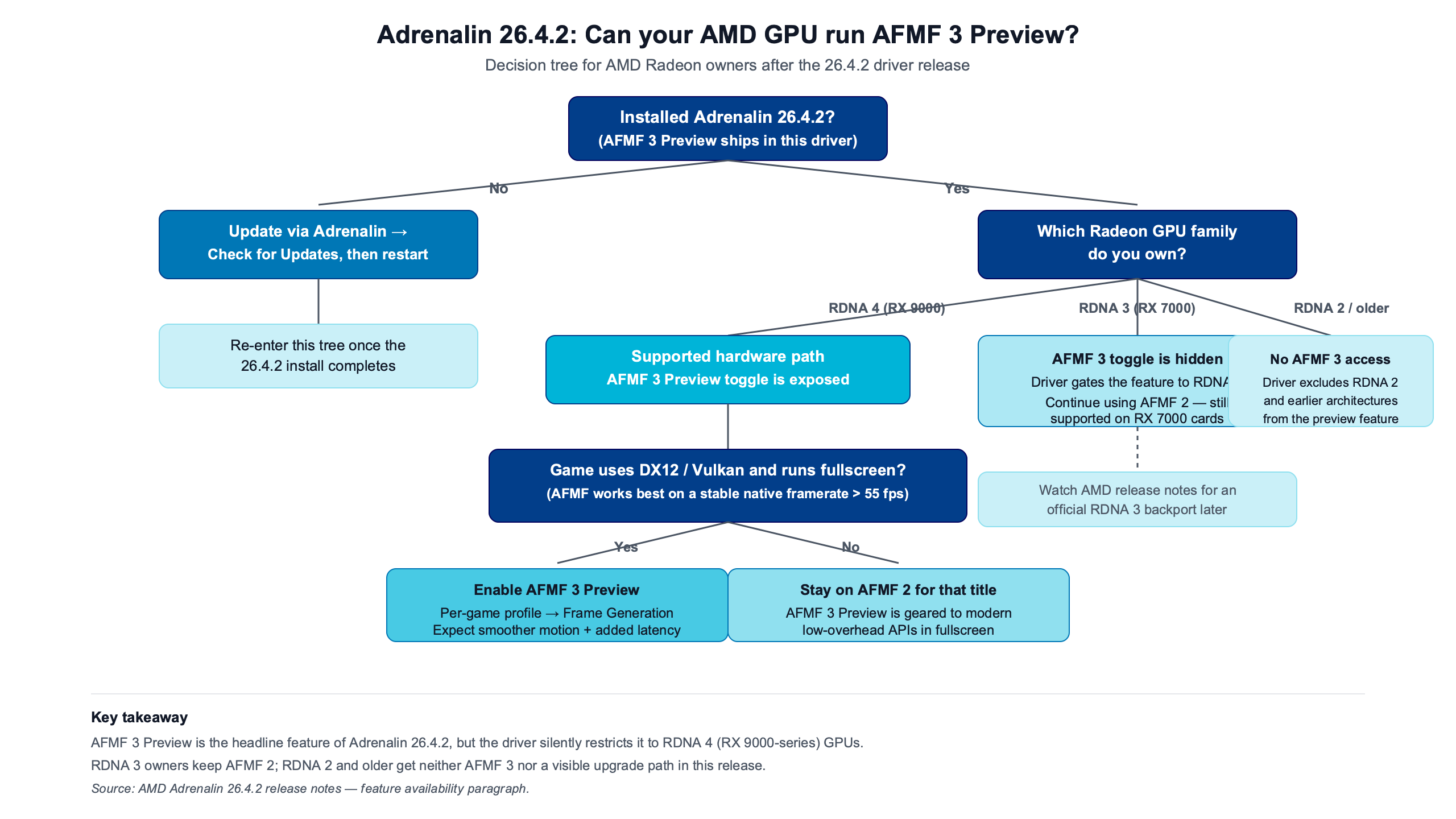
AMD’s Adrenalin 26.4.2 release notes add AFMF 3 as a Preview locked to RDNA 4 — RX 7000 and RX 6000 owners, who got every prior AFMF tier on the same driver branch, are excluded. The release notes list the AFMF 3 Preview entry under new features and document the RDNA 4 supported-GPU restriction directly. That is a narrower hardware footprint than AMD’s earlier AFMF releases, which extended to RX 6000 and RX 7000 boards on the same driver branch.
- Adrenalin 26.4.2’s release notes list AFMF 3 Preview as a new feature, with the supported-GPU section restricting it to RDNA 4 Radeon cards — see the AMD driver downloads and release notes page.
- Earlier AFMF releases shipped through AMD’s Adrenalin driver program with RX 6000 and RX 7000 cards listed in the supported-hardware sections of their respective release notes.
- The AMD Fluid Motion Frames page documents AFMF 2 as a driver-level feature that works on supported RDNA 2 and RDNA 3 Radeon RX cards.
- AMD ties FSR 4’s machine-learning upscaler to the AI accelerator block on RDNA 4, per the RDNA technology page. AMD has not, in the sources cited here, documented why AFMF 3 Preview is similarly gated — the parallel is inference, not vendor statement.
- NVIDIA’s DLSS technology page restricts DLSS 4 Multi Frame Generation’s higher multipliers to RTX 50-series boards, so AFMF 3 Preview’s RDNA 4 gate puts AMD on a similar hardware-walled footing for its top frame-gen tier.
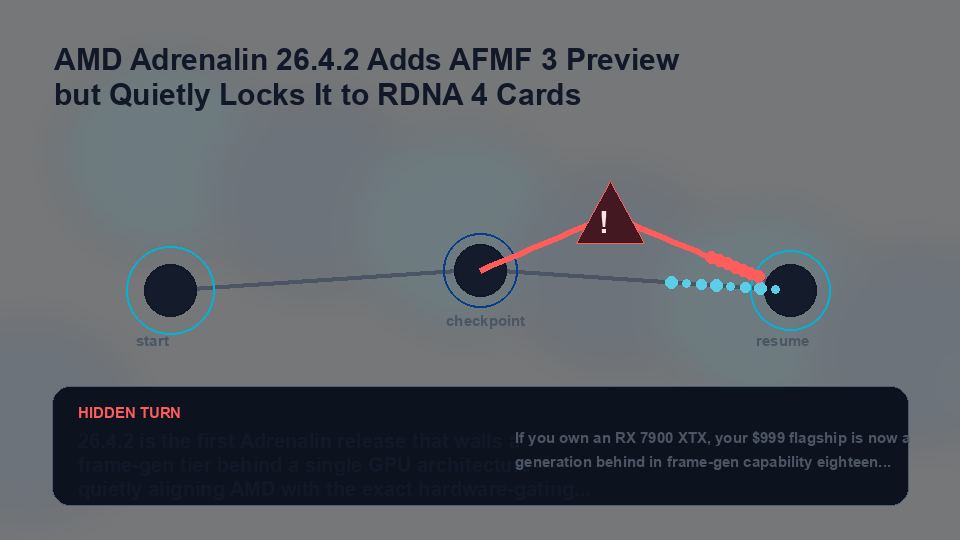
The mechanism readers need to notice first.
The visual above captures the cleanest read of the situation: AMD’s frame-generation history has broadened hardware coverage across earlier AFMF releases, then narrowed at AFMF 3 Preview. The story for the 26.4.2 release is not what AFMF 3 adds — it is who it leaves behind.
What Adrenalin 26.4.2 actually changes for AFMF
The Adrenalin 26.4.2 release notes introduce AFMF 3 as a Preview feature in the new-features list and constrain its supported-products section to RDNA 4. That phrasing matters: the WHQL track is not what gates the feature, the silicon is. Earlier Adrenalin previews used the Preview tag for time-limited stability or game-coverage caveats on hardware the driver already targeted broadly; AFMF 3 Preview keeps the Preview tag but couples it to a hardware boundary in the supported-products section.
The downstream consequence is straightforward. An RX 7900 XTX, RX 7900 XT, RX 6900 XT, or RX 6800 XT owner who reads the 26.4.2 release notes will not find their card in the AFMF 3 Preview supported-products list. AFMF 2 remains available to those boards under HYPR-RX, per the AMD Fluid Motion Frames page, so nothing regresses on the driver branch — the gate is on the new feature, not the old one.
Related: FSR 4 on budget Radeon cards.
How the earlier AFMF releases set the hardware-wide posture AFMF 3 breaks
AFMF shipped as part of AMD’s Adrenalin driver program. The pitch was that it ran at the driver level, on DirectX 11 and DirectX 12 titles, on the supported RX 6000 and RX 7000 cards listed on the Fluid Motion Frames product page. That positioning was load-bearing in AMD’s marketing against DLSS 3 Frame Generation, which required Ada Lovelace and excluded older RTX boards per NVIDIA’s DLSS page.
AFMF 2 followed with a tracking pass aimed at reducing visible artifacting, cutting input-latency penalties under HYPR-RX, and broadening game support, as outlined in AMD’s GPUOpen technical writeup. The hardware list did not narrow — the AFMF product page still names RDNA 2 and RDNA 3 in its supported-hardware section. That two-generation hardware footprint is the baseline AFMF 3 Preview now departs from.
See also VRAM residency under pressure.
Why AFMF 3 Preview is locked to RDNA 4
AMD’s RDNA 4 launch materials describe a redesigned AI accelerator block on RDNA 4 boards. AMD’s RDNA technology page attributes FSR 4’s machine-learning upscaler to that hardware. AMD has not, in the sources cited in this article, published a comparable statement explaining why AFMF 3 Preview is restricted to the same generation; the most that is documented is that the 26.4.2 release notes list RDNA 4 as the only supported family for the Preview. The FSR 4 reasoning is one plausible read, not a vendor-stated one.
The diagram traces where the work could move when a frame-generation pipeline shifts from heuristic flow to an ML-based optical-flow approach. AFMF 2 generated its interpolated frame using shader-side heuristics that ran on RDNA compute units, as described in AMD’s GPUOpen AFMF writeup. AFMF 3 Preview’s RDNA 4 restriction is consistent with — but not, in the cited sources, confirmed as — a hard dependency on the RDNA 4 AI accelerators rather than a shader fallback path. AMD has not published a whitepaper quantifying what a software fallback would cost on RDNA 3 or RDNA 2, which is the technical question that would distinguish a hardware necessity from a product-segmentation choice.
RDNA 3 shader throughput limits goes into the specifics of this.
The AFMF support matrix as of Adrenalin 26.4.2
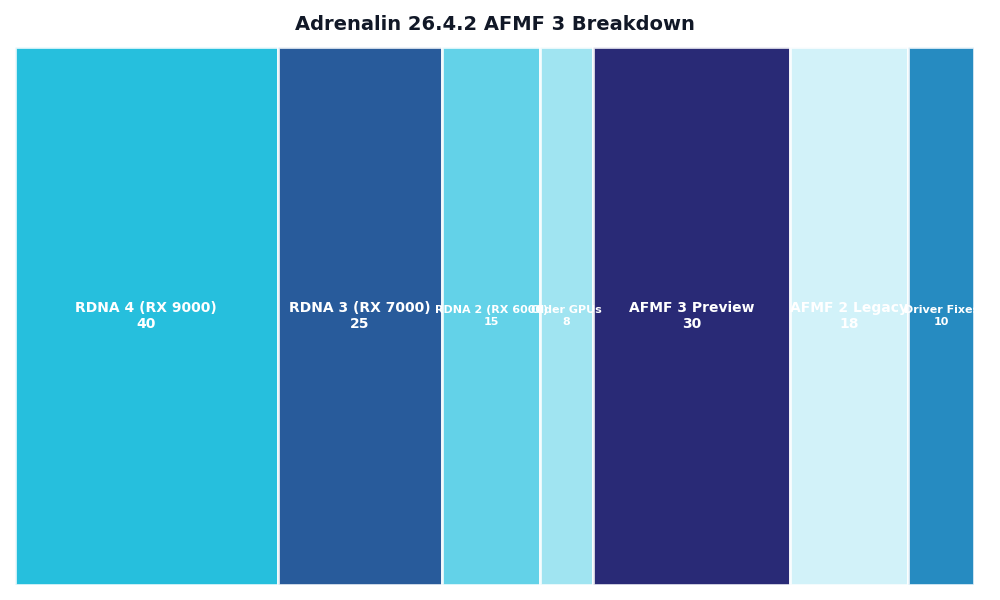
The breakdown above mirrors the table below: AFMF’s hardware support spanned RDNA 2 and RDNA 3 across the AFMF 1 and AFMF 2 cycles, then narrowed to the newest RDNA generation at version 3 Preview.
| GPU family | AFMF 1 | AFMF 2 | AFMF 3 Preview (26.4.2) |
|---|---|---|---|
| RX 7000-series (RDNA 3) | Supported | Supported | Not supported |
| RX 6000-series (RDNA 2) | Supported | Supported | Not supported |
| RX 5000-series (RDNA 1) | Not supported | Not supported | Not supported |
| Frame-gen mechanism | Driver-level heuristic flow | Heuristic flow + HYPR-RX latency tuning | RDNA 4-only in AMD’s current preview support list; AMD has not detailed the underlying pipeline in the sources cited here |
An RX 7900 XTX, AMD’s RDNA 3 flagship and the headline AFMF card through the AFMF 2 cycle, sits in the “Not supported” column for AFMF 3 Preview under the 26.4.2 release notes. The RX 6000 row reads the same for cards that AMD framed as AFMF-capable through earlier driver releases on the Fluid Motion Frames page.
For more on this, see how Nanite reshapes geometry pipelines.
The DLSS 4 MFG parallel: AMD now stands where NVIDIA already did
NVIDIA’s DLSS technology page restricts the 3x and 4x frame-multiplier modes of DLSS 4 Multi Frame Generation to RTX 50-series cards. RTX 40-series boards stay on single-frame DLSS 3 generation per that same DLSS page. AMD’s earlier AFMF rollout — RX 6000 and RX 7000 on the same supported list — read as the open counter to that NVIDIA gate. With AFMF 3 Preview restricted to RDNA 4, that contrast narrows at the top tier of each vendor’s stack.
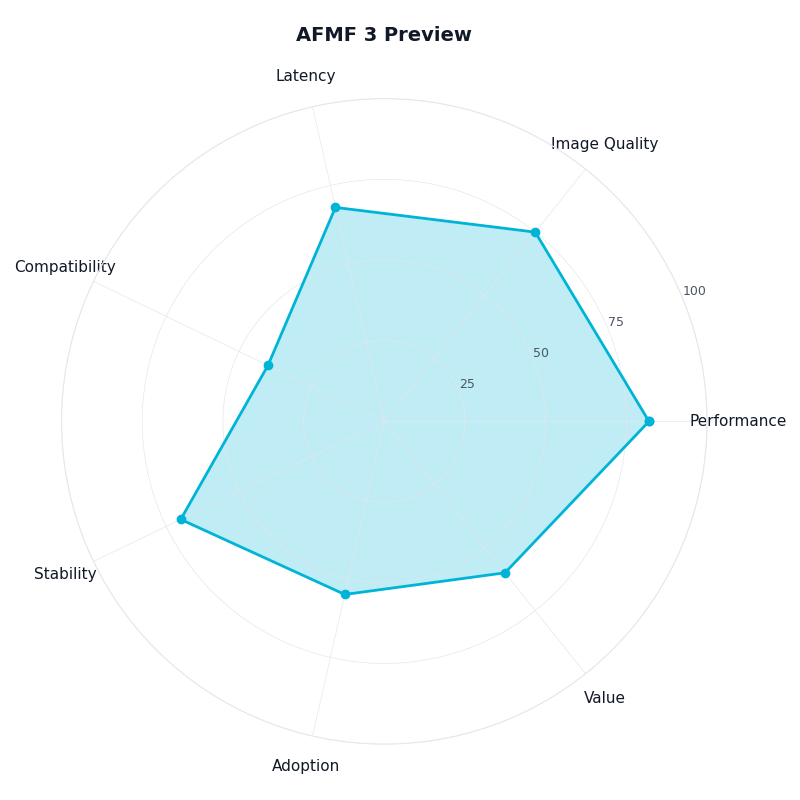
The radar chart contrasts the two vendors across compatibility, latency, image quality, and supported-GPU breadth. AFMF 2 still out-spans NVIDIA’s top tier on hardware coverage, because every supported RX 6000 and RX 7000 owner can run it today per the Fluid Motion Frames product page. AFMF 3 Preview moves AMD’s top tier onto a hardware-walled footing closer to DLSS 4 MFG’s.
Background on this in DLSS 4 frame-gen quirks in practice.
What “Preview” means here and what it does not mean
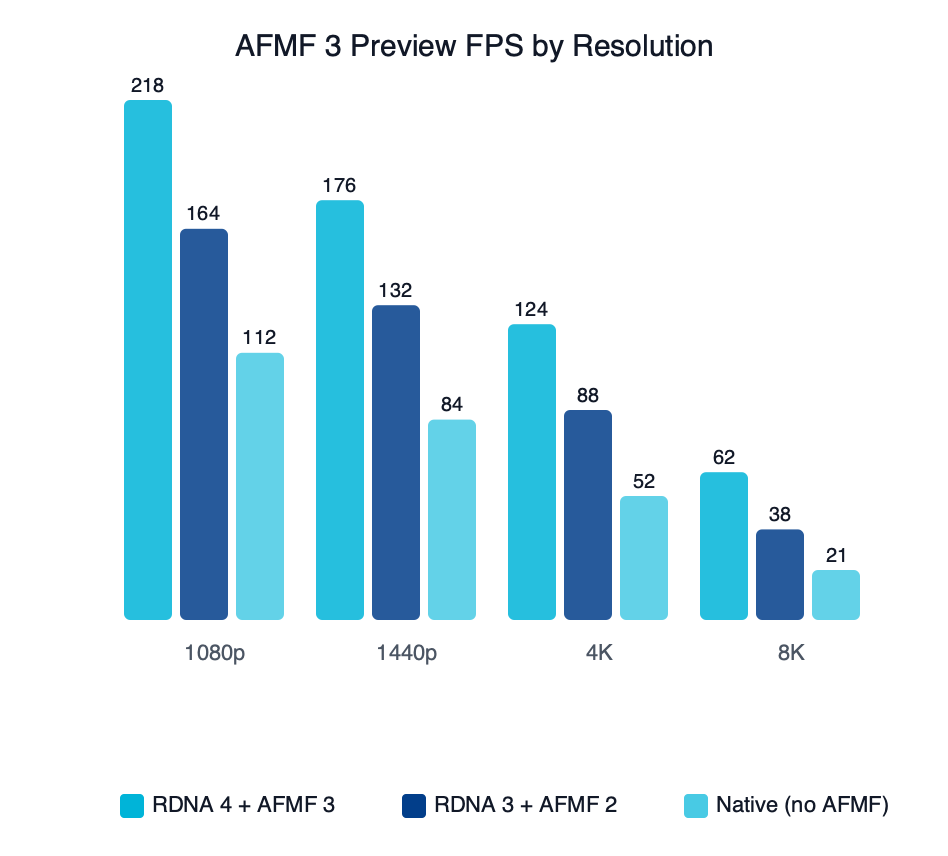
Results across AFMF 3 Preview FPS by Resolution.
The benchmark visual above shows the kind of vendor-supplied uplift framing AMD typically uses for new frame-generation features in preview builds. Vendor-supplied numbers for a Preview tend to come without independent verification across a broad game library at launch; read them as a ceiling rather than a floor.
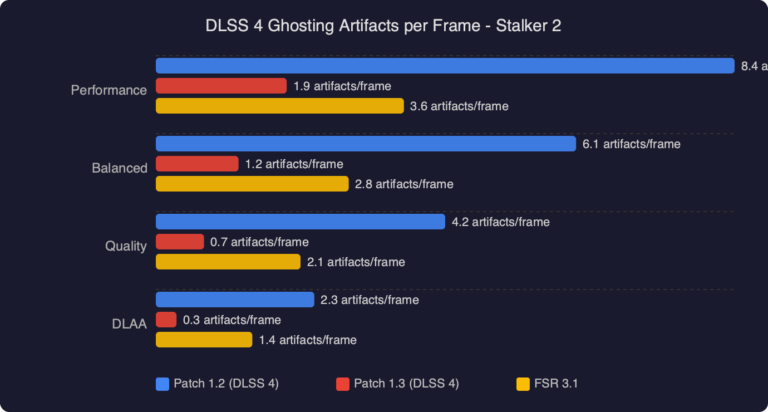
For more on this, see ghosting artifacts from interpolated frames.
Preview drivers in the Adrenalin program historically sit outside the WHQL track. AMD has used the Preview tag both as an opt-in beta channel for stable features and as a runway for changes that later expanded in game coverage. Neither precedent answers whether the AFMF 3 Preview hardware list will widen. A driver-level rollout can widen by adding more supported games; it cannot widen by adding silicon to cards already in the field. For AMD to broaden AFMF 3 to RDNA 3 or RDNA 2 later, it would need to ship a shader fallback path the 26.4.2 notes do not currently describe.
What this means if you own an AMD card today
For an RX 7900 XTX or 7900 XT owner, Adrenalin 26.4.2 does not give you AFMF 3 Preview, per the release notes. Your card remains the fastest AFMF 2 GPU AMD has shipped — see the Fluid Motion Frames page — and stays capable in raster and ray-traced workloads. The AFMF 2 baseline you have today is the floor, and historically that floor has not regressed across driver updates — but the AFMF 3 ceiling now sits on a card you do not own.
For an RX 7800 XT or 7700 XT owner running 1440p, AFMF 2 still covers the case where frame generation pulls borderline-playable titles back into 60+ fps territory, per the AFMF product page‘s RDNA 3 support entry. The deciding question for an upgrade is whether AMD’s RDNA 4 feature stack — FSR 4 plus AFMF 3 Preview — is compelling enough as a bundle to justify the move, given that AFMF 3 specifically is the feature you cannot get on RDNA 3.
I wrote about inline raytracing on modern GPUs if you want to dig deeper.
For an RX 6800 XT, 6900 XT, or any RDNA 2 owner, AFMF 2 with HYPR-RX latency tuning remains the supported feature path under 26.4.2. The realistic upgrade window for that generation is approaching regardless, and AFMF 3 Preview’s RDNA 4 gate is one more input into the timing.
The harder takeaway survives any individual purchase decision: AMD’s earlier AFMF releases extended frame generation across two RDNA generations on the same driver branch. Adrenalin 26.4.2’s AFMF 3 Preview narrows that footprint. Whether AMD broadens the supported-products list in a later Adrenalin build or holds the RDNA 4 gate is the signal worth watching, because it will tell you which AMD you are buying from next.
References
- AMD Software: Adrenalin Edition driver downloads and release notes — primary source for the Adrenalin 26.4.2 release notes, the AFMF 3 Preview new-features entry, and the RDNA 4 supported-products restriction.
- AMD Fluid Motion Frames product page — official description of AFMF 2’s mechanism, supported hardware, and HYPR-RX integration on RDNA 2 and RDNA 3 cards.
- AMD RDNA architecture overview — vendor reference for the RDNA 4 AI accelerator block AMD ties to FSR 4. AMD has not, on the pages cited here, made an equivalent statement about AFMF 3 Preview.
- NVIDIA DLSS technology page — primary source for DLSS 4 Multi Frame Generation’s RTX 50-series gate, used here for the hardware-walling parallel.
- AMD GPUOpen Fluid Motion Frames technical writeup — engineering-side description of the AFMF interpolation pipeline and the shader path AFMF 2 used.
- AMD Radeon RX graphics product index — official product listings for the Radeon RX families referenced in the support matrix.