



I’m done with “minimalism.” There, I said it.
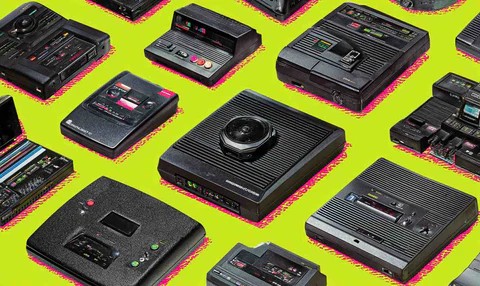
For the better part of a decade, my living room looked like a shrine to the God of Matte Black Plastic. You know the look. The router, the soundbar, the console, the TV bezel—everything blending into this homogenous, light-sucking void under the screen. It was “sleek.” It was “adult.”
It was incredibly boring.
I remember unwrapping my translucent purple Game Boy Color in the late 90s. That thing didn’t just play games; it screamed personality. It looked like candy. It looked like fun. Then, somewhere around 2013, the industry collectively decided that for gaming to be taken seriously, hardware had to disappear. We got boxes that looked like VCRs or air purifiers. We were told to hide our hobbies in plain sight.
But looking at the hardware trends hitting shelves this month—specifically the aggressive pivot toward neon, high-contrast, and “hyperpop” aesthetics—I think we’re finally waking up from that grayscale coma. And honestly? It’s about time.
The Engineering of “Loud”
This shift isn’t just about paint. It’s a fundamental change in industrial design philosophy that we’ve watched evolve over the last two years. When the current generation of consoles first launched, the modular side-panel approach felt like a gimmick. A way to sell us $50 plastic sheets. I was skeptical. I kept my stock white panels on for years because I didn’t see the point.
I was wrong.
From a manufacturing standpoint, moving the aesthetic layer away from the structural chassis was actually brilliant. It decoupled the thermal and mechanical engineering from the visual identity. In the past, a limited edition console meant a whole new SKU, a new production line, and a headache for retailers. Now? The internal hardware—the heatsinks, the APU, the fan curves—stays exactly the same. The “skin” is just a snap-on cowl.
This modularity is what’s allowing this new explosion of color. Manufacturers can take risks on weird, polarizing designs—like the searing electric pinks and acid yellows we’re seeing right now—without risking a warehouse full of unsold consoles. If the market hates the color, they just stop molding the plastic covers. The expensive silicon inside isn’t tied to the fashion choice.

The Y2K Aesthetic is Back (With Better Materials)
Let’s talk about this “Hyperpop” vibe that’s taking over 2026. It’s not subtle. We’re seeing a hard pivot away from the “earth tones” and “military green” that dominated the shooter craze of the 2010s. Now it’s all about high saturation. Cyan so bright it hurts your eyes. Magentas that look radioactive.
I picked up a set of these newer covers last week—mostly out of curiosity, partially because my cat scratched my original ones—and the material science has actually improved. The early faceplates felt cheap. Brittle. These new ones have a different texture, almost like a soft-touch coating but harder, more resistant to oils.
But the real visual impact comes from the contrast. Putting a neon yellow controller on a desk is one thing; wrapping the entire console in it changes the room’s energy. It reflects light differently. My entertainment center doesn’t look like a black hole anymore; it looks like an arcade cabinet from 1999 exploded.
Why We Crave the “Toy” Look Again
I think there’s a psychological reason this is hitting so hard right now. We spent so long trying to legitimize gaming as “cinema” or “art” that we stripped the joy out of the hardware. We wanted our PS4s and Xbox Ones to look like high-end AV equipment so our partners wouldn’t complain about them being in the living room.
But now? Gaming is the dominant cultural medium. We don’t need to hide it anymore. We don’t need to pretend it’s a Blu-ray player.
There’s also the fatigue with the “Apple-ification” of tech. Everything is aluminum, glass, and white plastic. It’s sterile. The resurgence of loud, unapologetic colors is a pushback against that sterility. It’s saying, “This is a toy. It’s for playing. It should look exciting.”
I was talking to a buddy of mine who runs a local repair shop, and he mentioned something interesting about these new saturated colors. They hide wear better. The matte black finishes of the last generation were fingerprint magnets. You looked at them wrong and they got greasy. These chaotic, bright patterns and neon finishes? You can handle them without needing a microfiber cloth on standby every five minutes.
The Third-Party Wild West
Of course, the official manufacturers are just catching up to what the modding community has been doing for years. I spent way too much time in 2024 scrolling through forums looking at custom spray-paint jobs and dipped shells. The difference now is accessibility.
You don’t need a Torx screwdriver and a heat gun anymore. You don’t need to void your warranty. You just pop a clip.
However, I have noticed a weird tension here. As the official first-party options get wilder and more “custom” looking, it’s actually putting pressure on the third-party makers like Dbrand or generic Amazon sellers. Why buy a knockoff plate when the official ones are finally giving us the designs we actually wanted? The official stuff used to be conservative and boring. Now that they’re releasing covers that look like graffiti or cyberpunk props, the cheap knockoffs are losing their main selling point.
Is It Just Nostalgia?
Maybe. I’m not gonna lie, seeing a controller that reminds me of my old neon green N64 pad triggers a dopamine hit that is probably unfair to my wallet. But I think it’s more than just retro-baiting.
It’s about personalization in a physical space. We spend hundreds of dollars on skins in Fortnite or Valorant because we want our digital avatars to look unique. It was inevitable that this desire would bleed back into the real world. Why should my character look like a neon demon while my console looks like a router?
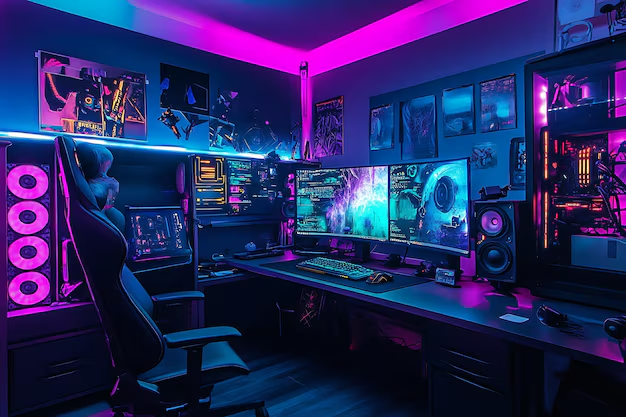
I’ve swapped my setup to this new high-contrast look—electric blue panels against a dark room—and it changes how I feel when I sit down to play. It feels like an event. It feels intentional.
The Technical Downside (Because There’s Always One)
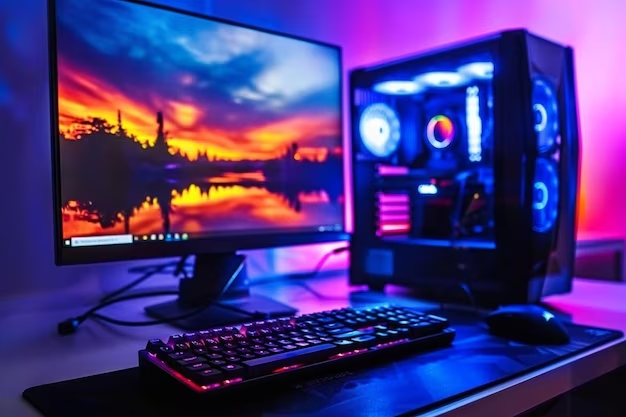
If I have one gripe with this new wave of “pop” aesthetics, it’s the LED situation. We’re seeing more accessories integrate lighting elements to match these bright shells, and implementation is… hit or miss. I had a controller recently where the battery life took a nosedive because the LEDs were pulling too much juice to match the aesthetic.
We need to be careful we don’t prioritize “looking cool” over “actually working for an 8-hour session.” Aesthetics should never compromise the thermals or the battery life. So far, the console covers are safe—they’re just plastic—but as we get into lighted stands and active-cooling faceplates (yes, those exist), the line gets blurry.
Let It Be Loud
So, if you’re still rocking the stock white or black plates that came with your system, maybe look at what’s out there right now. You don’t have to go full neon nightmare if that’s not your vibe. But the option to make your hardware look like something you own, rather than something you’re renting from a corporation, is powerful.
I’m keeping the loud colors. My living room is bright, chaotic, and looks a little bit like a laser tag arena. And honestly? I wouldn’t have it any other way.