The monumental success of the Steam Deck has done more than just put powerful PC gaming in our hands; it has fundamentally reshaped the conversation around Valve’s role as a hardware manufacturer. After the ambitious but ultimately flawed Steam Machines of the last decade, the Deck proved that Valve possesses the vision, engineering prowess, and software ecosystem to deliver a truly disruptive product. This triumph has reignited the imagination of the entire Gaming Community, fueling intense speculation and exciting Steam News. What comes next? The logical progression points towards a broader, more integrated hardware ecosystem designed to bring the flexibility and openness of PC Gaming to every screen in the home. This article delves into the persistent rumors and logical next steps for Valve, exploring the potential for a new generation of hardware—a dedicated streaming device, a revamped living room console, and a successor to a cult-classic controller—and what it could mean for the future of gaming.
The Post-Deck Era: Valve’s Renewed Hardware Ambitions
To understand where Valve might be going, it’s crucial to appreciate the ground they’ve already covered. The Steam Deck wasn’t just a product; it was a statement. It succeeded where previous efforts faltered by combining perfect timing with mature technology and a crystal-clear value proposition, setting the stage for what could be a full-scale hardware offensive.
The Legacy of the Steam Deck: A Game-Changing Success
The original Steam Machines failed primarily due to a fragmented hardware market and an immature operating system. At the time, SteamOS was a fledgling concept, and its Proton compatibility layer (then non-existent) was years away from seamlessly running a vast Windows library. Fast forward to the Steam Deck’s launch, and the landscape had changed dramatically. Proton had evolved into a robust, highly compatible translation layer, making a massive portion of the Steam library playable on Linux out of the box. This software maturity was the cornerstone of the Deck’s success. Valve also learned a critical lesson in hardware control; by designing a single, standardized spec, they gave developers a consistent target to optimize for, much like a traditional console. This focused approach, combined with aggressive pricing and a clear use case for handheld PC Gaming, created a phenomenon that continues to influence the Gaming Hardware market, from Gaming Laptops to other handheld PCs.
Reading the Tea Leaves: What’s Fueling the Speculation?
The current wave of Gaming News and speculation isn’t emerging from a vacuum. It’s fueled by Valve’s history of bold experimentation, from the innovative but niche Steam Controller to the high-fidelity Valve Index VR kit. Company president Gabe Newell has openly discussed the Steam Deck as a multi-generational product category, implying a long-term roadmap. The logical expansion of this roadmap is an ecosystem that addresses the different ways people play. The core ideas circulating within the community point to three distinct but interconnected hardware concepts: a lightweight device for game streaming, a powerful micro-console for the living room, and a next-generation controller to unify the experience. Together, these pieces could form a comprehensive ecosystem that challenges the established order of Console Gaming and solidifies Steam’s dominance.
Deconstructing the Rumors: A Deep Dive into Potential Steam Hardware
If Valve is indeed building an ecosystem, each component would need to serve a specific purpose while working in harmony with the others. Let’s break down the most plausible next steps for Valve’s hardware division, analyzing what these hypothetical devices might look like and the problems they would aim to solve.
The “Steam Frame”: A Hub for Cloud and Local Streaming?
One of the most intriguing concepts is a small, dedicated device for streaming—let’s call it the “Steam Frame.” This wouldn’t be a powerful gaming machine itself, but rather a highly optimized receiver for Steam’s Remote Play and a potential gateway to Valve’s own Cloud Gaming service. Imagine a sleek, affordable box or dongle that plugs directly into a TV or Gaming Monitor. Its primary job would be to decode a high-fidelity video stream with minimal latency. To achieve this, it would likely feature cutting-edge networking tech like Wi-Fi 7 and a dedicated AV1 hardware decoder. This device could serve two key scenarios: streaming games from your powerful Gaming PC in another room or, more disruptively, streaming directly from Valve’s cloud servers, creating a direct competitor to services like Xbox Cloud Gaming. This would be a crucial piece of Gaming Tech for making high-end gaming accessible without expensive local hardware.
Steam Machine 2.0: Vengeance for the Living Room PC
The idea of a “Steam Machine” is due for a revival, but this time, it would be built on the successful foundation of the Steam Deck. A “Steam Machine 2.0” would be a compact, console-like PC designed specifically for the living room. It would run the same polished, controller-friendly SteamOS 3 (or a future version) that Deck users love. Internally, it would likely be powered by a next-generation custom AMD APU, offering a significant performance leap over the Deck to target 1080p or 1440p resolutions in demanding AAA Games. Unlike the first-generation’s confusing array of third-party boxes, Valve would likely offer a single, first-party reference design. This would provide the plug-and-play simplicity of a PlayStation or Xbox while retaining the core PC advantage: access to the entire Steam library, frequent sales, and the potential for user upgrades (like adding more RAM or a larger SSD). This could be the ultimate bridge between the curated world of consoles and the open chaos of traditional Gaming PCs.
The Steam Controller 2: Refining a Cult Classic
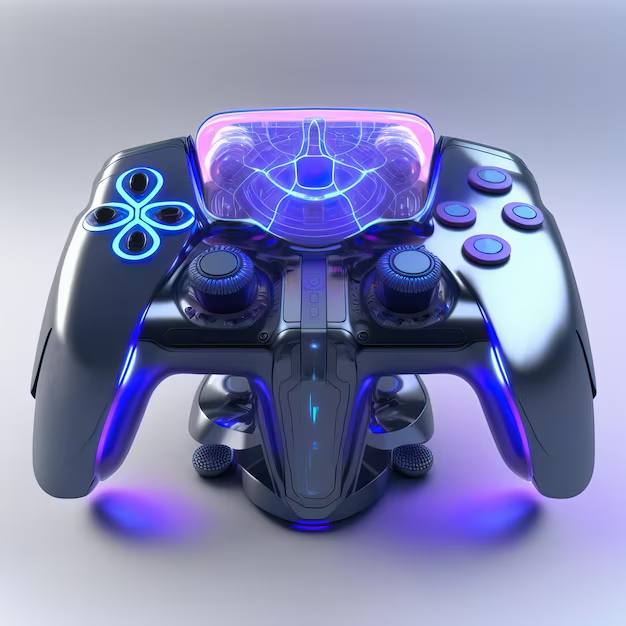
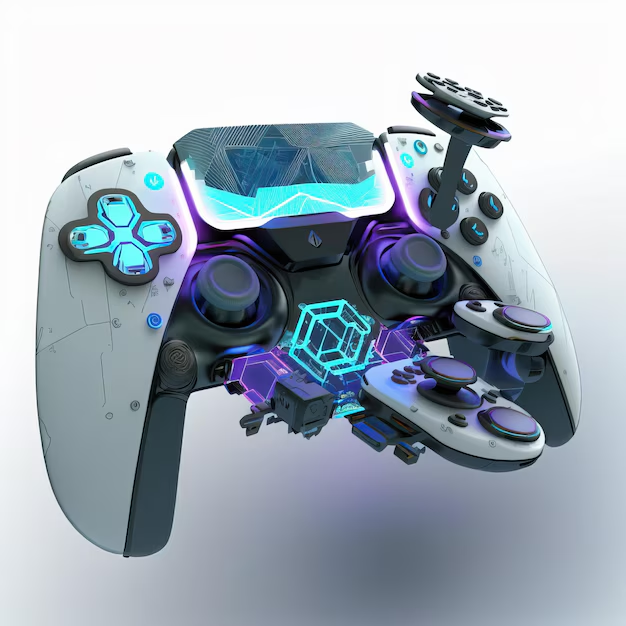
The original Steam Controller was a brilliant, deeply flawed masterpiece. Its dual trackpads offered unparalleled precision for genres like Strategy Games and FPS Games that typically demand a mouse. However, its ergonomics and learning curve were divisive. A “Steam Controller 2” is perhaps the most requested piece of Gaming Peripherals from the community. A successor would likely keep the iconic dual trackpads while incorporating modern features. We could expect Hall effect analog sticks to eliminate drift, vastly improved HD haptics for more immersive feedback, and better overall build quality. Valve could even integrate a small OLED screen for displaying control schemes or notifications, borrowing a design cue from the Steam Deck. A refined Steam Controller wouldn’t just be an accessory; it would be the unifying input device across the entire ecosystem—Deck, PC, and the new Steam Machine—offering a consistent, highly customizable experience for every type of game, from Indie Games to massive MMORPG News titles like Final Fantasy XIV.
The Ecosystem Effect: Implications for the Broader Gaming Industry
The introduction of a cohesive hardware family from Valve would send shockwaves through the entire Gaming Industry. It represents a direct challenge not just to other hardware makers, but to the fundamental philosophies that have governed platform exclusivity and game development for decades.
Unifying the PC Gaming Experience
For years, the greatest strength of PC Gaming—its openness—has also been a source of fragmentation. Different launchers, hardware configurations, and driver issues can create friction. A Valve hardware ecosystem could offer a more streamlined, “just works” experience without sacrificing openness. Imagine playing an RPG Game on your Steam Deck on the bus, then seamlessly continuing on your TV via the Steam Machine 2.0 when you get home. If you’re in a room with just a monitor, you could use the “Steam Frame” to stream the game from your main PC. This Apple-like integration, built on an open software platform (Linux), is a powerful proposition that could attract millions of players who desire the simplicity of a console but don’t want to abandon their extensive Steam libraries or pay for online multiplayer.
A New Paradigm for Game Developers
For those in Game Development, a standardized set of Valve hardware targets would be a significant boon. Optimizing a game for the Steam Deck has already become a priority for many studios. Adding a “Steam Machine 2.0” to the mix creates another clear performance target, simplifying the QA and development process. This is especially relevant for developers using popular engines, with both Unity News and Unreal Engine News frequently highlighting improved support for Linux and Vulkan. Furthermore, as Valve continues to pour resources into Proton, it makes the PC the primary development platform, with deployment to a Linux-based console becoming a near-effortless byproduct. This lowers the barrier to entry and reduces development costs, fostering a healthier environment for both AAA Games and Indie Games.
Shaking Up the Console and Cloud Markets
A full-fledged Valve ecosystem is a direct assault on the walled gardens of Sony, Microsoft, and Nintendo. The latest PlayStation News and Xbox News often revolve around exclusive titles and subscription services. Valve’s counter-argument is a massive, pre-existing library that players already own, with no monthly fee for online play. A powerful and affordable Steam Machine could be a compelling alternative to a PS5 or Xbox Series X. Simultaneously, a dedicated streaming device backed by Valve’s infrastructure would challenge the Cloud Gaming ambitions of Microsoft, NVIDIA, and Amazon. This competition is ultimately great for consumers, driving innovation and more competitive pricing across the board.
Navigating the Challenges: Hurdles and Opportunities for Valve
Despite the immense potential, Valve’s path is not without significant obstacles. Launching a successful hardware ecosystem requires more than just great engineering; it demands flawless execution in logistics, marketing, and software support, areas where even the largest tech giants can stumble.
Potential Pitfalls: Lessons from the Past
The most significant hurdle is market penetration and mindshare. Sony, Microsoft, and Nintendo have spent decades and billions of dollars building their brands and retail channels. Valve, by contrast, has primarily been a digital-first company. To compete in the living room, they must solve the retail and marketing puzzle. Another critical pitfall is software compatibility. While Proton is a modern marvel, it’s not perfect. Certain major multiplayer titles, particularly those with aggressive kernel-level anti-cheat like Valorant or some Call of Duty entries, remain a challenge. For a living room console to succeed, it must be able to play the most popular games on day one without issue. Finally, pricing is paramount. The Steam Deck’s success was intrinsically linked to its incredible value. A Steam Machine 2.0 would need to hit a similarly aggressive price point to tempt users away from established consoles.
Key Considerations for Success
To overcome these challenges, Valve must lean into its unique strengths. First and foremost is the Gaming Community. The vibrant modding and homebrew scene around the Steam Deck is a testament to the power of an engaged user base. Valve should continue to foster this openness, as it creates a legion of evangelists. Second, they must double down on the value proposition of the Steam platform: no paid online, frequent deep-discount sales, and a library that carries forward forever. This is a powerful message against the rising costs of console gaming. Finally, they need to ensure a seamless user experience. The “it just works” factor is what sells consoles. SteamOS must be rock-solid, intuitive, and fast, delivering a polished experience that rivals or exceeds that of its competitors from the moment you press the power button.
The Future is Open: Final Thoughts on Valve’s Hardware Horizon
While the specifics remain speculative, the direction of travel for Valve seems clear. The triumph of the Steam Deck was not an endpoint but a new beginning, proving there is a massive appetite for open, flexible, and powerful gaming hardware. The potential for a new generation of devices—a Steam Machine for the living room, a Steam Frame for effortless streaming, and a refined Steam Controller to tie it all together—represents one of the most exciting developments in the Gaming Industry.
If Valve can successfully navigate the challenges of manufacturing, marketing, and software polish, they could create a truly unified ecosystem that offers the best of both worlds: the simplicity and convenience of a console with the freedom and value of PC Gaming. This vision doesn’t just promise new gadgets; it promises a more open, competitive, and player-centric future for everyone, forever changing the landscape of how and where we play our favorite Video Games.